




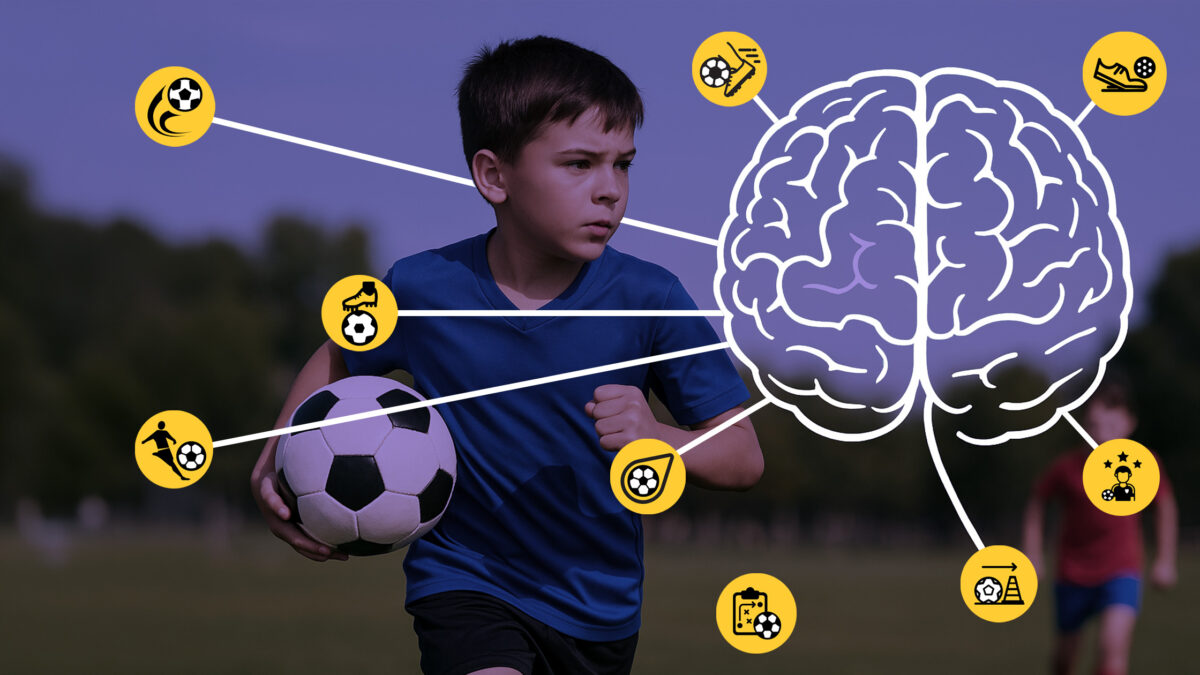
As a parent, you probably have a good idea of the physical benefits of sports and soccer for your child. It keeps them active, supports their physical health, and helps burn off that last bit of energy before bedtime. But beyond the physical benefits, soccer can also play a transformative role in supporting your child’s healthy cognitive development.
In this article, we’ll explore exactly how soccer can help boost your child’s cognitive development — whether your kid is playing in a league or just kicking a ball around in the backyard with the family.
______________
What Is Cognitive Development?
In short, cognitive development is the process of how a child learns to understand and think about the world around them (Rabindran & Madanagopal, 2020). This includes how they interact with others, think logically, and solve problems.
Healthy cognitive development in childhood is crucial for future success in school, work, and life. Many different activities can encourage this growth — including imaginative play, problem-solving games, and puzzles (Malik & Marwaha, 2023).
And while it might not be the first thing that comes to mind, sports like soccer can significantly boost your child’s cognitive development — particularly in areas like attention, decision-making, and a skill known as cognitive flexibility.
______________
Pay Attention, Please!
If you’ve ever asked your child to focus — whether while teaching them a new card game, helping with homework, or reminding them to eat dinner instead of playing with it — you already know attention is a skill kids must develop over time.
Healthy attention skills are essential for learning and avoiding distractions. Fortunately, there are many ways to encourage attention development — and playing soccer is one of them!
Research shows that children who play soccer regularly demonstrate stronger attention skills compared to those who don’t participate in sports. They are able to stay focused longer and are less easily distracted (Moratal et al., 2020).
Even short bursts of activity can help. Studies show that just one instance of physical exercise can lead to immediate improvements in focus (Greeff et al., 2018). Want better homework concentration? A quick game of soccer in the yard might do the trick.
______________
Shoot or Pass?
A young soccer player is approaching the goal and notices a teammate in a better scoring position. Do they shoot or pass? This moment requires the player to quickly assess the field, weigh options, and predict outcomes — all critical decision-making skills.
Decision-making is a crucial part of cognitive growth. Children develop this skill by making choices, experiencing consequences, and gradually learning to take responsibility. Parents can support this process by encouraging thoughtful choices and praising good decisions (Stanford).
Soccer naturally provides endless opportunities for practicing this skill. Every pass, shot, or defensive move requires kids to make quick choices in a dynamic environment — helping them learn not just the game, but also how to think critically and respond to changing situations (Hicheur et al., 2017; Kolovelonis et al., 2022).
______________
Act Fast, Act Flexibly
Soccer often demands split-second decisions. But it’s not just about running fast — it’s about thinking fast.
Imagine a player receives the ball and suddenly an opponent is rushing toward them. In an instant, they must decide whether to pass, dribble, or shoot, and adjust based on where their teammates and opponents are. This is a perfect example of cognitive flexibility in action.
Cognitive flexibility is the ability to adapt your thinking and behavior to new situations. For kids, this skill helps them switch between tasks, follow changing rules, and understand different perspectives (Tong et al., 2024).
Soccer helps develop this skill by constantly forcing players to adjust to the game’s ever-changing flow. In one study comparing young soccer players, gymnasts, and non-athletes, soccer players showed the highest levels of cognitive flexibility and attention (Bizdan-Bluma et al., 2024).
Every practice, scrimmage, and pickup game isn’t just improving your child’s soccer skills — it’s helping them become a sharper, more adaptable thinker.
______________
Sources:
- Bidzan-Bluma, I., Jurek, P., & Lipowska, M. (2024). Cognitive functions in pre-adolescent children involved in gymnastic and soccer. Advances in Cognitive Psychology, 20, Article 2. https://doi.org/10.5709/acp-0424-8
- Cognitive development in adolescence. Cognitive Development in Adolescence – Stanford Medicine Children’s Health. (n.d.). https://www.stanfordchildrens.org/en/topic/default?id=cognitive-development-in-adolescence-90-P01594
- De Greeff, J. W., Bosker, R. J., Oosterlaan, J., Visscher, C., & Hartman, E. (2018). Effects of physical activity on executive functions, attention and academic performance in preadolescent children: a meta-analysis. Journal of science and medicine in sport, 21(5), 501-507.
- Hicheur, H., Chauvin, A., Chassot, S., Chenevière, X., & Taube, W. (2017). Effects of age on the soccer-specific cognitive-motor performance of elite young soccer players: Comparison between objective measurements and coaches’ evaluation. PLoS one, 12(9), e0185460.
- Kolovelonis, A., Pesce, C., & Goudas, M. (2022). The effects of a cognitively challenging physical activity intervention on school children’s executive functions and motivational regulations. International journal of environmental research and public health, 19(19), 12742.
- Malik, F., & Marwaha, R. (2023). Cognitive development. In StatPearls [Internet]. StatPearls Publishing.
- Moratal, C., Lupiáñez, J., Ballester, R., & Huertas, F. (2020). Deliberate soccer practice modulates attentional functioning in children. Frontiers in Psychology, 11, 533108
- Rabindran, & Madanagopal, D. (2020). Piaget’s theory and stages of cognitive development- an overview. Scholars Journal of Applied Medical Sciences, 8(9), 2152–2157. https://doi.org/10.36347/sjams.2020.v08i09.034
- Tong, K., Fu, X., Hoo, N. P., Kean Mun, L., Vassiliu, C., Langley, C., Sahakian, B. J., & Leong, V. (2024). The development of cognitive flexibility and its implications for mental health disorders. Psychological medicine, 54(12), 1–7. Advance online publication. https://doi.org/10.1017/S0033291724001508