




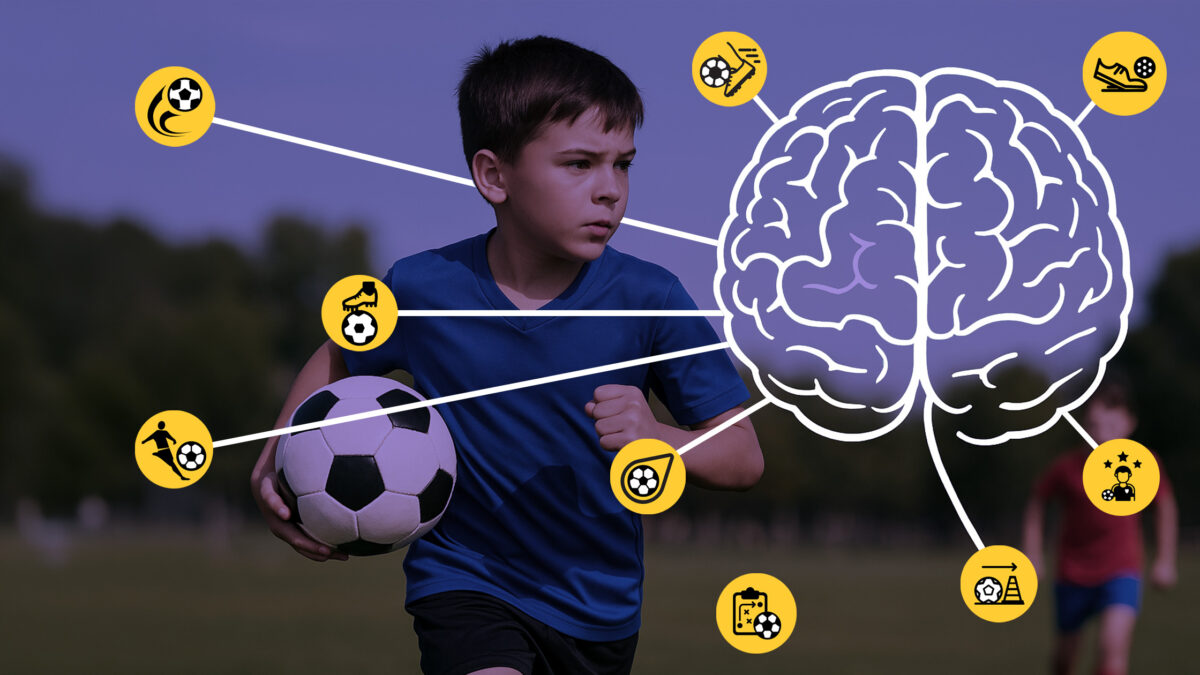
How Football Supports Your Child’s Cognitive Development
As a parent, you probably have a good idea of the physical benefits of sport and football for your child. It keeps them active, supports their physical health, and helps get out that last bit of energy from the day before bedtime. But beyond the physical benefits, football can also play a transformative role in supporting your child’s healthy cognitive development.
In this article, we will explore exactly how football can help boost your child’s healthy cognitive development, whether your kid is playing in a league or just kicking a ball around in the backyard with the family.
___________________
What is Cognitive Development?
In short, cognitive development is the process of how a child learns to understand and think about the world around them (Rabindran & Madanagopal, 2020). This includes how your child interacts with the world, how they think logically about their surroundings, and how they problem-solve.
Healthy cognitive development in childhood is crucial for future success in work, school, and life. Lots of different activities can help encourage this development in children, including imaginative play, problem-solving games, or puzzles (Malik & Marwaha, 2023).
While it may not be the first thing that comes to mind, sports like football can also massively boost your child’s healthy cognitive development, especially in areas like attention, decision making, and a skill known as cognitive flexibility.
_________________
Pay Attention, Please!
You’ve likely had plenty of experience in asking your child to focus. This could be while you’re showing them a new card game, helping them with their homework, or trying to get them to eat their dinner instead of just play with it. While it may not always be obvious, a child begins developing attention skills as an infant and develops them throughout childhood and into adulthood.
Healthy attention skills are essential for your child’s ability to learn and avoid being easily distracted. Luckily, there are many ways to help encourage your child’s healthy attention development, and playing football is one of them!
Research shows that regularly playing football is associated with increased attention in young children. In a recent study, researchers compared the attention spans of children who regularly played football to those who did not participate in any sports and found that the football players were able to stay focused longer and were less easily distracted (Moratal et al., 2020).
Alongside long-term benefits, football can also lead to immediate improvements in your child’s attention. Many researchers have found that even just one instance of physical activity can lead to an immediate improvement in a child’s ability to focus (Greeff et al., 2018). Want your child to pay attention better during homework time? Maybe the answer lies in kicking the ball around a bit beforehand.
_________________
Shoot or Pass?
A footballer is nearing the goal and notices that their teammate may be in a better position to score; do they shoot or pass? This is an important question that must be answered after the player assesses the pitch, weighs their options, and predicts the potential outcomes, all of which require great decision-making skills.
Another crucial part of your child’s cognitive growth is the development of their decision-making. Children learn this skill throughout childhood as they make both good and bad decisions, understand the consequences, and gradually take responsibility for these choices.
Parents can encourage good decision-making at home by encouraging thoughtfulness and praising good choices (Stanford). Playing football offers a natural and exciting way to practice this, since your child is constantly making decisions on what move to make next in a dynamic and engaging environment. Children also learn natural consequences from these decisions, like if their choice to go for the shot instead of passing leads to missing out on a goal.
According to experts on child development, playing football requires advanced decision-making and observational skills to navigate the frequently changing environment of teammates and opponents (Hicheur et al., 2017). Because of this, researchers are now looking at football as a fun tool to promote cognitive development in primary school students (Kolovelonis et al., 2022). A kickaround in the park is more than just fun, it’s encouraging your child to become a more thoughtful and capable decision-maker!
_________________
Act Fast, Act Flexibly
Players often must act fast during a football game. You may immediately think of physical speed, but it is the mental agility that separates the good players from the great ones.
Think about when a player receives the ball, but a member on the opposing team is suddenly rushing toward them. In a split second, this player must decide: Should I pass the ball? Who do I pass it to? Where is that teammate right now? What direction should I kick it in? How hard? All these decisions are made nearly immediately and is a great example of professional footballers’ well-developed cognitive flexibility.
Cognitive flexibility is the ability to change your thinking and behaviour in response to changing situations. For your child, this is important for them to know how to adapt to rules in different environments, switch between tasks, and even understand different people’s perspectives (Tong et al., 2024).
Football helps your child develop cognitive flexibility by requiring them to constantly read and adapt to what is happening in the game around them. In fact, researchers recently tested the cognitive abilities of young football players (ages 10-12) with both young gymnasts and children who did not play any sports. The study found that the children who played football showed higher cognitive flexibility and attention compared to both the gymnasts and the non-athletes (Bizdan-Bluma et al., 2024) . Each drill and pick-up game doesn’t just make your child a better player, but a sharper thinker, too!
_________________
Sources:
- Bidzan-Bluma, I., Jurek, P., & Lipowska, M. (2024). Cognitive functions in pre-adolescent children involved in gymnastic and soccer. Advances in Cognitive Psychology, 20, Article 2. https://doi.org/10.5709/acp-0424-8
- Cognitive development in adolescence. Cognitive Development in Adolescence – Stanford Medicine Children’s Health. (n.d.). https://www.stanfordchildrens.org/en/topic/default?id=cognitive-development-in-adolescence-90-P01594
- De Greeff, J. W., Bosker, R. J., Oosterlaan, J., Visscher, C., & Hartman, E. (2018). Effects of physical activity on executive functions, attention and academic performance in preadolescent children: a meta-analysis. Journal of science and medicine in sport, 21(5), 501-507.
- Hicheur, H., Chauvin, A., Chassot, S., Chenevière, X., & Taube, W. (2017). Effects of age on the soccer-specific cognitive-motor performance of elite young soccer players: Comparison between objective measurements and coaches’ evaluation. PLoS one, 12(9), e0185460.
- Kolovelonis, A., Pesce, C., & Goudas, M. (2022). The effects of a cognitively challenging physical activity intervention on school children’s executive functions and motivational regulations. International journal of environmental research and public health, 19(19), 12742.
- Malik, F., & Marwaha, R. (2023). Cognitive development. In StatPearls [Internet]. StatPearls Publishing.
- Moratal, C., Lupiáñez, J., Ballester, R., & Huertas, F. (2020). Deliberate soccer practice modulates attentional functioning in children. Frontiers in Psychology, 11, 533108
- Rabindran, & Madanagopal, D. (2020). Piaget’s theory and stages of cognitive development- an overview. Scholars Journal of Applied Medical Sciences, 8(9), 2152–2157. https://doi.org/10.36347/sjams.2020.v08i09.034
- Tong, K., Fu, X., Hoo, N. P., Kean Mun, L., Vassiliu, C., Langley, C., Sahakian, B. J., & Leong, V. (2024). The development of cognitive flexibility and its implications for mental health disorders. Psychological medicine, 54(12), 1–7. Advance online publication. https://doi.org/10.1017/S0033291724001508